Followers of my Blog

Thursday, January 12, 2017

WHETHER A NON-SHAREHOLDER OF A COMPANY HAS THE RIGHT TO INSPECT THE DOCUMENTS OR ATTEND AGM OF THE COMPANY UNDER SECTION 163 OF COMPANIES ACT- NO SAYS NCLT, MUMBAI BENCH.

WHETHER A NON-SHAREHOLDER OF A COMPANY HAS THE RIGHT TO INSPECT THE DOCUMENTS OR ATTEND AGM OF THE COMPANY UNDER SECTION 163 OF COMPANIES ACT- NO SAYS NCLT, MUMBAI BENCH. 

Mr. Anil Kumar Poddar versus M/s. Reliance Corporate IT Park Ltd. and Others

Right to receive the copies of Company documents - Right to inspection of the documents – the Meaning of Qualified person u/s. 163

Mr. Anil Kumar Poddar versus M/s. Reliance Corporate IT Park Ltd. and Others

Right to receive the copies of Company documents - Right to inspection of the documents – the Meaning of Qualified person u/s. 163


Held that:- This Petitioner has no shareholding in the company, therefore, he will not get any occasion to attend Annual General Meetings of the company or any of the meeting of the company to question the acts of the company. 

Hence, this Bench does not see any rationale in granting such a relief to a stranger to the company because by giving a conjoint meaning of the person mentioned in sub-section 2 of Section 163 - member or debenture holder and of any other persons, this Petitioner will not fall under any of the above three classes of persons, therefore, this Petitioner is not entitled to seek this relief u/s. 163.


This Bench having noticed that this Petitioner is in the habit of raising frivolous litigation again many of the listed companies either by subscribing one or two shares or under the head of "any other person" u/s. 163 by asking inspection of the documents from the date of inception of the companies. 

Knowing fully well, that it will not be possible to provide inspection of the documents from the date of inception, when the company failed to provide inspection or supply of copies, he files Petitions u/s. 163 or sec. 219 of the Companies Act, 1956. If any company says copies are provided as sought by the Petitioner, he will start arguing for exemplary costs for not providing inspection in the period mentioned in the statute.

Since this Bench has noticed that he is not a qualified person u/s. 163 to seek inspection, this Bench hereby dismisses all these 62 Petitions by imposing cost of ₹ 1000/- each in every TCP.

Sunday, January 1, 2017

Check-list for Publishing quarterly/half-yearly results by listed companies and limited review report

Check-list for Publishing quarterly/half-yearly results by listed companies and limited review report

The Listing Agreement [LA] entered into by listed companies with stock exchange(s) [SEs] requires under clause 41 publishing of quarterly/half-yearly results by listed companies. The requirements are listed hereunder :

1) Quarterly Results [QR]
  1. A company shall publish unaudited financial results on quarterly basis as per proforma given hereafter within one month of the end of the quarter to the SEs and immediately after market hours on the date of Board Meeting
  1. The results shall also be published in a daily newspaper with national circulation and in one regional language daily newspaper within 48 hours of the Board Meeting.
  1. The results shall be signed by the MD/Director
  1. At least 7 days before the Board Meeting, the company shall inform the SEs about the Board Meeting
  1. Any change of name in the company suggesting new line of business should disclose the turnover and income, etc. from the new activities separately for 3 years from the date of name change
  1. The unaudited results should not substantially differ from the audited results by 20% otherwise reasons for the difference should be explained to the SEs
  1. Unaudited QR for the last quarter need not be published if the company informs the SE in advance that it will publish audited results within 3 months from the end of the accounting year of the company

  1. The QR shall be prepared on the basis of accrual accounting policy and in accordance with uniform accounting practices adopted for all the periods on quarterly basis

  1. With effect from quarter ending on or after June, 2003 the QR shall be subjected to Limited Review by the auditors.

  1. The format of limited review report (LRR) is given hereafter.

  1. The LRR shall be submitted to the SEs within 2 months of the close of the quarter."

  1. The company will have the option to publish consolidated quarterly financial results in addition to the unaudited quarterly financial results of the parent company as required under this clause

  1. The company will publish its Annual Results in the same format as prescribed for quarterly results in this clause
2) Half-Yearly Results [HYR]
  1. The HYR shall be in the same format as the QR and shall be subject to limited review by the auditors [discussed separately]
  1. The format of limited review report [LRR] is given hereafter
  1. The LRR shall be submitted to the SEs within 2 months of the end of the half-year

  1. The QR of the 2 quarters contained in the half-year should not vary more than 20% of its sum total otherwise a statement of reasons should be sent to the SEs

  1. To the extent possible, requirements in items relating to QR shall apply to HYR also.
FORMAT OF UNAUDITED FINANCIAL RESULTS FOR THREE MONTHS ENDED XX-XX-20XX
Part I (Rs.In lakhs)
Particulars
3 months ended (dd/mm/yyyy)
Preceding
3 months
ended (dd/mm/yyyy)
Corresponding
3 months
ended in the previous year
(dd/mm/yyyy)
Year to date
figures for
current period
ended
(dd/mm/yyyy)
Year to date
figures for the previous
year ended
(dd/mm/yyyy)
 Previous
accounting year ended
(dd/mm/yyyy)
1 Income from operations
  1. Net Sales/Income from Operations
  2. Other Operating Income
2 Expenditure
  1. Cost of materials consumed.
  2. Purchase in stock- in-trade
  3. Changes in inventories of finished goods, work-in-progress and stock-in-trade
  4. Employees benefits expenses
  5. Depreciation and Amortisation Expense
  6. Other expenditure
"Total(Any item exceeding 10% of the total expenditure to be shown separately)"
3 Profit/(Loss) from operations before other income, finance costs and exceptional items(1±2)
4 Other Income
5 Proftit / Loss from ordinary activity before finance costs and exceptional items (3±4)
6 Finance costs
7 Profit / (Loss) from ordinary activities after finance costsbut before exceptional items (5±6)
8 Exceptional items
9 Profit / (Loss) from Ordinary Activities before tax (7±8)
10 Tax expense
11 Net Profit / (Loss) from Ordinary Activities after tax (9±10)
12 "Extraordinary Item(net of tax expense Rs.____)"
13 Net Profit / (Loss) for the period (11 ± 12)
14 Share of Profit / (Loss) of associates*
15 Minority interest*
16 "Net Profit / (Loss) after taxes, minority interest and share of profit / (loss) of associates.(13 ± 14 ± 15)*"
17 Paid-up equity share capital (Face Value of the Share shall be indicated)
18 Reserve excluding Revaluation Reserves as per balance sheet of previous accounting year
19 (i) "Earnings Per Share (EPS)”(before extraordinary items ) (of Rs.____/- each)(not annualised):
  1. Basic
  2. Diluted
20 (ii) "Earnings Per Share (EPS)”(after extraordinary items )(of Rs.____/- each)(not annualised):
  1. Basic
  2. Diluted
A Particulars of Shareholding
1 Public Shareholding
No. of shares
Percentage of shareholding
2 Promoters and promoter group shareholding **
  1. Pledged/Encumbered
Number of shares
Percentage of shares (as a% of the total shareholding of promoter and promoter group)
Percentage of shares (as a% of the total share capital of the company)
  1. Non-encumbered
Number of Shares
Percentage of shares (as a% of the total shareholding of promoter and promoter group)
Percentage of shares (as a % of the total share capital of the company)
B Investor Complaints
Pending at beginning of quarter
Received during the quarter
Disposed of during the quarter
Remaining unresolved at the end of the quarter


*Applicable in case of consolidated results.

Note: The classification/disclosure of items in the financial results shall be in accordance with the Revised Schedule VI of the Companies Act, 1956. Further to the above, profit/loss from discontinuing operations, if any, included in the above shall be disclosed with details thereof.

Courtesy : Bombay Chartered Accountant's Association 

Friday, December 30, 2016

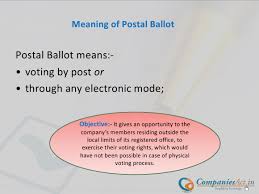
A to Z about Postal Ballot


A to Z about Postal Ballot

A company shall transact the following business only by means of voting through a postal ballot as notified in Rule 22 of Companies (Management and Administration) Rules, 2014:

a.   Alteration of the objects clause of the memorandum and in the case of the company in existence immediately before the commencement of the Act, alteration of the main objects of the memorandum;

b.   Alteration of Articles of Association in relation to insertion or removal of provisions which, under sub-section (68) of section 2, are required to be included in the articles of a company in order to constitute it a private company;

c.   Change in place of registered office outside the local limits of any city, town or village;

d.   Change in objects for which a company has raised money from public through prospectus and still has any unutilised amount out of the money so raised;

e.   Issue of shares with differential rights as to voting or dividend or otherwise;

f.    Variation in the rights attached to a class of shares or debentures or other securities;

g.   Buy-back of shares by a company;

h.   Election of a director by small shareholders;

i.     Sale of the whole or substantially the whole of an undertaking of a company as specified under sub-clause (a) of sub-section (1) of section 180;

j.     Giving loans or extending guarantee or providing security in excess of the limit specified under sub-section (3) of section 186:

A company may transact any item of business through postal ballot other than ordinary business and any business wherein the directors or auditors have a right to be heard at any meeting.


If a resolution is assented to by the requisite majority of the shareholders by means of postal ballot, it shall be deemed to have been duly passed at a general meeting convened in that behalf.

One Person Company and other companies having members up to two hundred are not required to transact any business through postal ballot.

Procedure to be followed for conducting business through postal ballot

1) Where a company is required or decides to pass any resolution by way of postal ballot, it shall send a notice to all the shareholders, along with a draft resolution explaining the reasons therefore and requesting them to send their assent or dissent in writing on a postal ballot by post or through electronic means within 30 days from the date of dispatch of the notice.

2) The notice shall be sent either by:-

a.   Registered Post or speed post, or

b.   Electronic means like registered e-mail, or

c.   Courier service.

3) An advertisement shall be published at least once in a vernacular newspaper in the principal vernacular language of the district in which the registered office of the company is situated and in English language in English newspaper, having a wide circulation in that district, about having dispatched the ballot papers and specifying therein, inter alia, the following matters, namely:-

a.   A statement to the effect that the business is to be transacted by postal ballot which includes voting by electronic means;

b.   The date of completion of dispatch of notices;

c.   The date of commencement of voting;

d.   The date of end of voting;

e.   The statement that any postal ballot received from the member beyond the said date will not be valid and voting whether by post or by electronic means shall not be allowed beyond the said date;

f.    A statement to the effect that members, who have not received postal ballot forms may apply to the company and obtain a duplicate thereof; and

g.   Contact details of the person responsible to address the grievances connected with the voting by postal ballot including voting by electronic means.

4) The notice of the postal ballot shall also be placed on the website of the company after the notice is sent to the members and shall remain on such website till the last date for receipt of the postal ballots from the members.

5) The Board of Directors shall appoint one scrutiniser who is willing to be appointed as such. He should not be in employment of the company and should in the opinion of the Board be able to conduct the postal ballot voting process in a fair and transparent manner.

6) Postal ballot received shall be kept in the safe custody of the scrutiniser till the chairman considers, approves and signs the minutes. No person shall deface or destroy the ballot paper or declare the identity of the shareholder.

7) The scrutiniser shall submit his report as soon as possible within 7 days of the last date of receipt of postal ballots;

8) The scrutiniser shall maintain a register either manually or electronically to record their assent or dissent received, mentioning the particulars of name, address, folio number or client ID of the shareholder, number of shares held by them, nominal value of such shares, whether the shares have differential voting rights, if any, details of postal ballots which are received in defaced or mutilated form and postal ballot forms which are invalid.

9) The scrutiniser shall return the ballot papers and other related papers or register to the company who shall preserve such ballot papers and other related papers or register safely.

10) The assent or dissent received after thirty days from the date of issue of notice shall be treated as if reply from the member has not been received.

11) The results shall be declared by placing it, along with the scrutiniser’s report, on the website of the company.

12) The resolution shall be deemed to be passed on the date of at a meeting convened in that behalf.


13) The provisions of rules regarding voting by electronic means shall apply, as far as applicable, mutatis mutandis to this rule in respect of the voting by electronic means.

Courtesy -Bombay Chartered Accountants’ Society

Wednesday, December 28, 2016

Reduction of Share Capital – An Overview & Check-list

Reduction of Share Capital – An Overview & Check-list

1. INTRODUCTION

The need of reducing share capital may arise in various circumstances, for example, accumulated business losses, assets of reduced or doubtful value, etc. As a result, the original capital may either have become lost or a company may find that it has more resources that it can profitably employ. In either of these cases, the need may arise to reduce the share capital.


2. COMPANIES ACT, 2013

While the new Companies Act, 2013 has come into force, some of the sections including those governing reduction of share capital are yet to be notified. Till then the provisions under the Companies Act, 1956 shall continue to apply.

The provisions relating to capital reduction under the new Companies Act, 2013 are as under:

2.1 Power of the company for reduction of share capital

For a company to reduce its share capital, it should have the power under its Articles of Association to do so. If the articles do not contain any provision for reduction of capital, the articles must first be altered so as to give such power and then the special resolution for reducing capital must be passed. The reduction effected by such resolution must be confirmed by the National Company Law Tribunal (‘Tribunal’). No capital reduction can be undertaken if the company is in arrears in the repayment of any deposits (including interest payable thereon) accepted by it. [Section 66]


2.2 Modes of reduction of share capital

The Act does not prescribe the manner in which the reduction of capital is to be effected nor is there any limitation on the power of the Tribunal to confirm the reduction, except that it must be satisfied that every creditor of the company has either consented to the said reduction or they have been paid off or their interest has been secured.

Reduction of share capital may be effected in one of the following ways:

1.     In respect of share capital not paid-up, extinguishing or reducing the liability on any of its shares. (For example, if the shares are of face value of INR 100 each of which INR 75 has been paid, the company may reduce them to INR 75 fully paid-up shares and thus relieve the shareholders from liability on the uncalled capital of INR 25 per share); or

2.     Cancel any paid-up share capital, which is lost, or is not represented by available assets. This may be done either with or without extinguishing or reducing liability on any of its shares (For example, if the shares of face value of INR 100 each fully paid-up is represented by INR 75 worth of assets. In such a case, reduction of share capital may be effected by cancelling INR 25 per share and writing off similar amount of assets); or

3.     Pay off the paid-up share capital, which is in excess of the needs of the company. This may be achieved either with or without extinguishing or reducing liability on any of its shares. (For example, shares of face value of INR 100 each fully paid-up can be reduced to face value of INR 75 each by paying back INR 25 per share.)

Paid-up share capital for the purpose of capital reduction would include securities premium and capital redemption reserve.


3. PROCEDURAL ASPECTS AS PER COMPANIES ACT, 2013

3.1 Special Resolution

Unless a special resolution, as authorised by the articles, is passed for reduction of share capital, a company cannot effect share capital reduction.
However, in the following cases there is no need to follow the process as provided in section 66,
1.     Where redeemable preference shares are redeemed in accordance with the provisions of sections 55.
2.     Where any shares are forfeited for non-payment of calls, though the forfeiture as a fact amounts to a reduction of capital.
3.     Where the nominal share capital of a company is reduced by cancelling any shares, which have not been taken or agreed to be taken by any person. (Section 61)
4.     Where company purchases its own shares in accordance with provisions of section 68.

3.2 Tribunal Sanction

5.     Next step would be to make an application to the Tribunal for obtaining the sanction to reduction. Before confirming the reduction the Tribunal shall give notice of the application to the Central Government, Registrar and SEBI (in case of listed companies) and creditors of the company and take into consideration their representations.
6.     If no representation is received from the Central Government, Registrar, SEBI or the creditors within the period of 3 months, it would be presumed that they have no objection to the reduction.
7.     The Tribunal will not sanction the scheme unless :
8.     It is satisfied that every creditor of the company has either consented to the said reduction or their debt/claim has been secured or discharged.
9.     The accounting treatment, proposed by the company for such reduction is in conformity with the accounting standards specified in section 133 or any other provision of this Act and a certificate to that effect by the company’s auditor has been filed with the Tribunal
10.                        The order of confirmation of the reduction of share capital by the Tribunal is to be published by the company in such manner as the Tribunal may direct.
  1. The company has to deliver the certified copy of the order of the Tribunal to the Registrar within 30 days of the receipt of the copy of the order, who shall register the same and issue a certificate to that effect.

4. REDUCTION OF CAPITAL UNDER SECTION 242

Apart from reduction of capital under section 66, there is another circumstance, when share capital can be reduced. In the case of oppression and mismanagement, the Tribunal has been given powers under section 242 to pass an order as it thinks fit which may provide for purchase of shares of any members by the company and consequent reduction of the share capital.

5. IMPLICATIONS UNDER INCOME-TAX ACT, 1961 (‘IT Act’)

When any company reduces the share capital as per the provisions of the Companies Act, 2013 by way of reducing the face value of shares or by way of paying off part of the share capital, it amounts to extinguishment of the rights of the shareholder to the extent of reduction of share capital. Therefore it is regarded as transfer under section 2(47) of the IT Act and would be chargeable to tax.
The income received on capital reduction would be taxable as under:
  • Amounts distributed by the company on capital reduction to the extent of its accumulated profits will be considered as deemed dividend under section 2(22)(d) and the company will have to pay dividend distribution tax on the same,
  • Distribution over and above the accumulated profits, in excess of original cost of acquisition of shares would be chargeable to capital gains tax in the hands of the shareholders.
Slump Sale

Meaning of REDUCTION OF CAPITAL UNDER SECTION 242
In simple words, ‘slump sale’ is nothing but transfer of a whole or part of business concern as a going concern; lock, stock and barrel. As per section 2(42C) of Income -tax Act 1961, ‘slump sale’ means the transfer of one or more undertakings as a result of the sale for a lump sum consideration without values being assigned to the individual assets and liabilities in such sales.
‘Undertaking’ has the same meaning as in Explanation 1 to section 2(19AA) defining ‘demerger’. As per Explanation 1 to section 2(19AA), ‘undertaking’ shall include any part of an undertaking or a unit or division of an undertaking or a business activity taken as a whole, but does not include individual assets or liabilities or any combination thereof not constituting a business activity.
Explanation 2 to section 2(42C) clarifies that the determination of value of an asset or liability for the payment of stamp duty, registration fees, similar taxes, etc. shall not be regarded as assignment of values to individual assets and liabilities. Thus, if value is assigned to land for stamp duty purposes, the transaction will be a qualifying slump sale under section 2(42C)
A sale in order to constitute a slump sale must satisfy the following quick test:
1.     Business is sold off as a whole and as a going concern
2.     Sale for a lump sum consideration
3.     Materials available on record do not indicate item-wise value of the assets transferred

Analysis of the above definitions

1.     The subject matter of slump sale shall be an undertaking of an Assessee.
2.     An ‘undertaking’ may be owned by a corporate entity or a non-corporate entity, including a professional firm.
3.     Slump sale may be of a single undertaking or even more than one undertaking.
4.     The undertaking has to be transferred as a result of sale.
5.     The consideration for transfer is a lump sum consideration. This consideration should be arrived at without assigning values to individual assets and liabilities. The consideration may be discharged in cash or by issuing shares of Transferor Company.
6.     Possibility of identification of price attributable to individual items (plant, machinery and dead stock) which are sold as part of slump sale, may not entitle a transaction to be qualified as slump sale — CIT vs. Artex Manufacturing Co., [227 ITR 260 (SC)]. However, in case of slump sale which includes land/building where separate value is assigned to it under the relevant stamp duty legislation, the slump sale will not be adversely affected in the light of Explanation 2 to section 2(42C).
7.     Transfer of assets without transfer of liabilities is not a slump sale

Taxability of gains arising on slump sale

Section 50B of the Income-tax Act, 1961 provides the mechanism for computation of capital gains arising on slump sale. On a plain reading of the Section, some basic points which arise are:
1.     Section 50B reads as ‘Special provision for computation of capital gains in case of slump sale’. Since slump sale is governed by a ‘special provision’, this section overrides all other provisions of the Act.
2.     Capital gains arising on transfer of an undertaking are deemed to be long-term capital gains. However, if the undertaking is ‘owned and held’ for not more than 36 months immediately before the date of transfer, gains shall be treated as short-term capital gains.
3.     Taxability arises in the year of transfer of the undertaking.
4.     Capital gains arising on slump sale are calculated as the difference between sale consideration and the net worth of the undertaking. Net worth is deemed to be the cost of acquisition and cost of improvement for section 48 and section 49 of the Act.
5.     As per section 50B, no indexation benefit is available on cost of acquisition, i.e., net worth.
6.     In case of slump sale of more than one undertaking, the computation should be done separately for each undertaking.

‘Net Worth’

Net worth is defined in Explanation 1 to section 50B as the difference between ‘the aggregate value of total assets of the undertaking or division’ and ‘the value of its liabilities as appearing in books of account’. This amendment has made it clear that the slump sale provisions apply to a non-corporate entity also.
The ‘aggregate value of total assets of the undertaking or division’ is the sum total of:
1.     WDV as determined u/s.43 (6)(c)(i)(C) in case of depreciable assets.
2.     The book value in case of other assets.

Companies Act implications

Section 180 of the Companies Act, 2013 imposes restrictions on the powers of the Board. One of the restrictions is ‘to sell, lease or otherwise dispose of the whole or substantially the whole of the undertaking of the company or where the company owns more than one undertaking, of the whole or substantially the whole of any of such undertakings.’

Therefore, in case of slump sale, section 180 shall get attracted and a special resolution of the members shall be required.

For the purpose of this section, ‘undertaking’ shall mean an undertaking in which investment of the company exceeds 20% of its net worth or which generates 20% of the total income.


‘Substantially the whole of the undertaking’ shall mean 20% or more of the value of undertaking.

Courtesy -Bombay Chartered Accountants’ Society